On 10 December 2025, the National Assembly officially promulgated the Law on Artificial Intelligence (“AI Law” or “Law”), which enters into force on 1 March 2026. This is Vietnam’s first comprehensive statute governing artificial intelligence. The Law consists of 35 Articles and is designed under a “management for development” approach, ensuring a balance between risk control and the promotion of innovation.
The Law adopts a human-centric approach, providing that artificial intelligence must serve humans, must not replace humans, and must remain subject to human oversight in important decision-making. However, it exhibits significant structural and technical ambiguities compared to mature regulatory frameworks, particularly the EU AI Act. While it adopts commendable principles and risk-based approaches, critical implementation gaps, undefined key concepts, and misalignment with technical industry practices create substantial compliance uncertainty.
The scope of regulation of the Law covers artificial intelligence activities, including research, development, provision, deployment, and use of AI systems; the rights and obligations of relevant organizations and individuals; and State management of artificial intelligence activities in Vietnam, except for AI activities exclusively serving national defence, national security, or cryptographic purposes.
The Law classifies AI systems into high-risk, medium-risk, and low-risk, which is similar to the risk-based approach provided under the EU AI Act and OECD guidelines. However, the different and vague thresholds need elaboration while EU Act already provides the list of specific high risk application under Annex III.
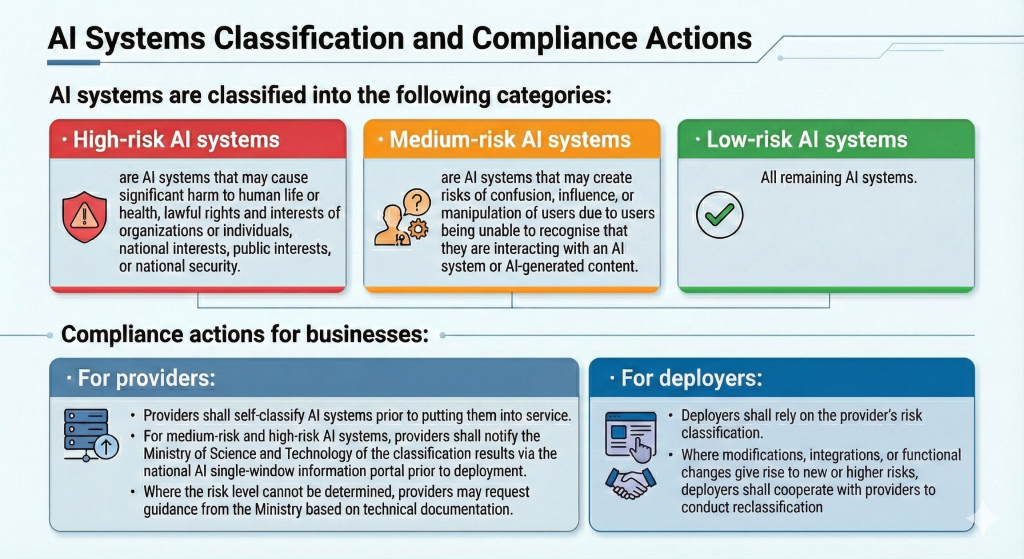
Providers shall self-classify AI systems prior to putting them into service. For medium-risk and high-risk AI systems, providers shall notify the Ministry of Science and Technology of the classification results via the national AI single-window information portal prior to deployment. Where the risk level cannot be determined, providers may request guidance from the Ministry based on technical documentation.
Deployers shall rely on the provider’s risk classification. Where modifications, integrations, or functional changes give rise to new or higher risks, deployers shall cooperate with providers to conduct reclassification.
In the absence of detailed guidelines, the stakeholders will all be put at risk of non-compliance and may be exposed to future penalties.
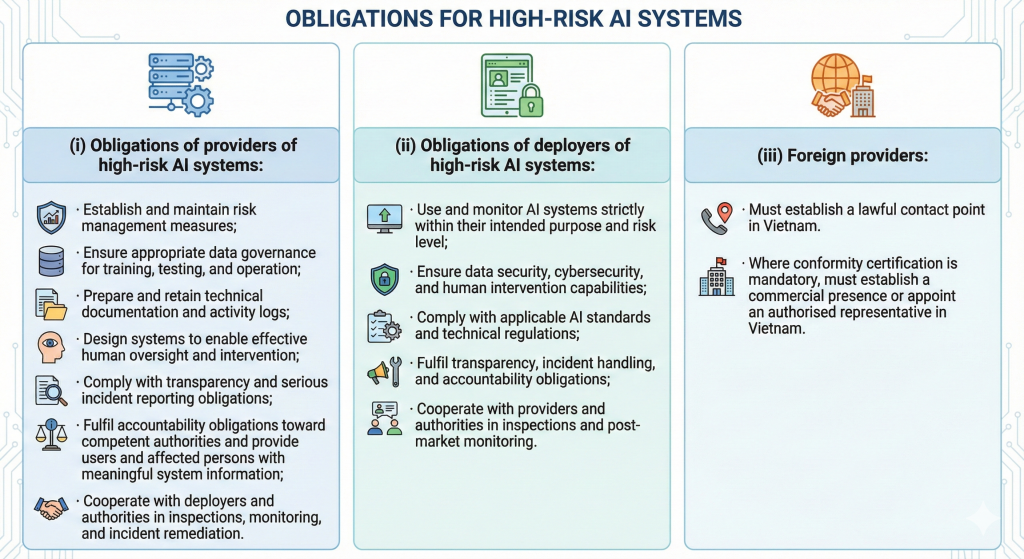
For high-risk AI systems that are required to obtain conformity certification before being put into service, the assessment must be carried out by conformity assessment bodies that are registered or officially recognised under the Law.
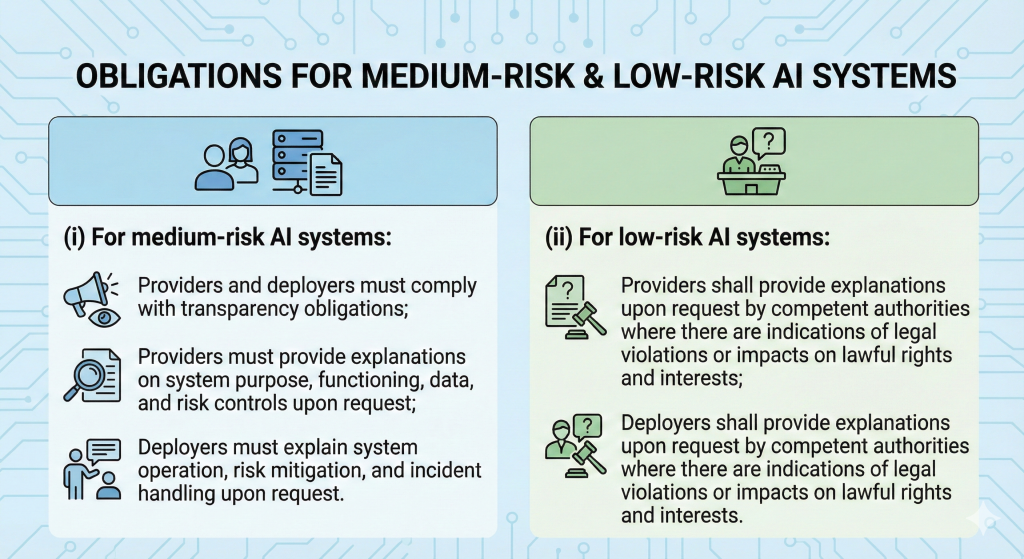
For AI systems that were put into operation prior to 1 March 2026, providers and deployers shall comply with AI system management obligations within the following time limits:
- 18 months from 1 March 2026 for AI systems used in healthcare, education, and financial services;
- 12 months from 1 March 2026 for AI systems not falling within the above categories.
In order to ensure transparency and enable users to recognise when they are interacting with AI systems or AI-generated content, providers and deployers are subject to the following obligations: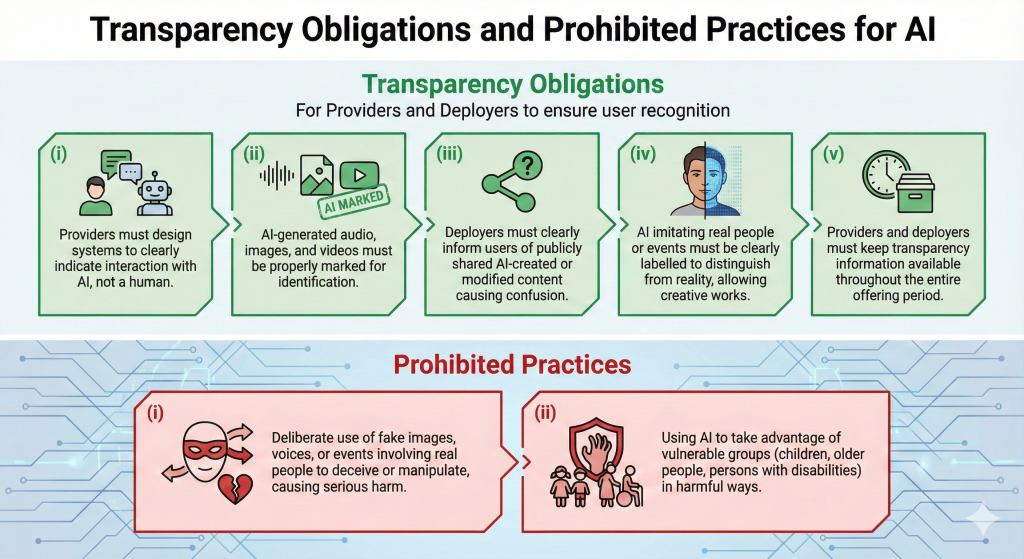
The AI Law marks an important step in Vietnam’s efforts to regulate artificial intelligence while promoting innovation. However, its effectiveness will largely depend on forthcoming guiding regulations that clarify risk classification, compliance thresholds, and practical implementation requirements.
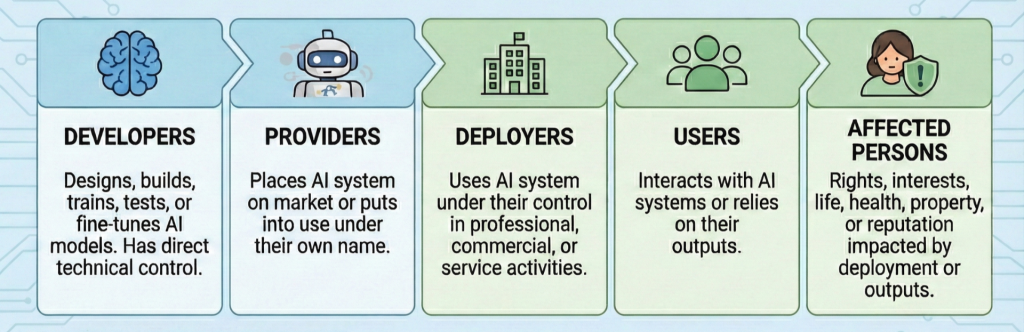
In the meantime, businesses involved in developing, providing, or deploying AI, the new Law means preparation cannot wait. Companies should start by identifying whether they act as developers, providers, or deployers, and by reviewing the risk level of the AI systems they currently use or plan to introduce. Putting basic compliance processes in place early and keeping a close watch on upcoming guidance from regulators will be key to avoiding uncertainty and compliance risks once the Law takes effect.